E-Signatures in Europe: Legal, Compliant, and Binding
Electronic signatures are legally binding across all 27 EU member states under the eIDAS Regulation. Learn how TurboDocx meets Advanced Electronic Signature (AES) requirements.
Quick Answer
Yes — electronic signatures are legally recognized across all 27 EU member states under the eIDAS Regulation (EU 910/2014). Advanced Electronic Signatures (AES) are widely accepted for everyday business contracts, and TurboDocx meets eIDAS AES requirements.
27 Member States
eIDAS since July 1, 2016
AES Implementation
What is eIDAS?
The eIDAS Regulation (Electronic Identification, Authentication and Trust Services — EU 910/2014) is the EU's legal framework governing electronic signatures, seals, timestamps, and trust services. It entered into force on July 1, 2016 and applies directly in all EU member states without requiring national transposition.
eIDAS establishes a key principle: an electronic signature cannot be denied legal effect solely because it is in electronic form (Article 25.1). This means electronic signatures are admissible as evidence in court across the entire EU. The regulation also ensures cross-border recognition — a signature valid in one member state must be accepted in all others.
For businesses operating across Europe, eIDAS eliminates the patchwork of national electronic signature laws and creates a single, unified legal framework. This is what makes it possible to sign contracts with partners in Germany, France, Spain, or any other EU country using the same electronic signature platform.
Three Levels of Electronic Signatures Under eIDAS
eIDAS defines three tiers of electronic signatures, each with increasing requirements and legal weight. Understanding these levels helps you choose the right approach for your contracts.
SESSimple Electronic Signature
Any data in electronic form attached to or associated with other data used to sign. Includes typed names, scanned signatures, and checkbox consent.
Legal Weight
Admissible as evidence but carries lowest evidential weight. The burden of proof falls on the party relying on the signature.
Common Use Cases
Email confirmations, click-to-accept terms, typed name in a form
AESAdvanced Electronic Signature
TurboDocx LevelUniquely linked to the signatory, capable of identifying them, created under their sole control, and linked to the signed data so any change is detectable.
Legal Weight
Strong evidential weight. Accepted for the vast majority of business contracts, employment agreements, procurement documents, and commercial transactions.
Common Use Cases
TurboSign signatures, most B2B and B2C contracts, HR documents, NDAs, SOWs
QESQualified Electronic Signature
An AES created by a qualified signature creation device and based on a qualified certificate issued by a government-accredited trust service provider.
Legal Weight
Automatically equivalent to a handwritten signature across all EU member states. Required only for specific regulated transactions.
Common Use Cases
Real estate transfers (some countries), notarial acts, certain public sector filings
Why AES works for most businesses: QES is typically required only for specific regulated transactions — such as real estate, notarial acts, and certain government filings. For most commercial contracts, NDAs, SOWs, and procurement documents, AES is widely accepted across EU member states. Requirements vary by jurisdiction and document type — consult local counsel for regulated transactions.
How TurboDocx Meets eIDAS AES Requirements
TurboSign, the e-signature engine within TurboDocx, implements every technical requirement for Advanced Electronic Signatures as defined by eIDAS Article 26.
Uniquely Linked to the Signatory
Article 26(a)Each signer is identified via a unique recipient ID with email-based verification. The audit trail cryptographically links every signature to a specific individual.
Capable of Identifying the Signatory
Article 26(b)Signer identity is captured and recorded with email address, IP address, device fingerprint, geolocation, and user agent — providing a comprehensive identification profile.
Under the Signatory's Sole Control
Article 26(c)Signing access is delivered exclusively to the signer's verified email address via a unique token. Only the intended recipient can authorize the signature.
Tamper-Evident Data Linkage
Article 26(d)SHA-256 cryptographic hashing with ETSI CAdES detached signatures ensures any modification to the signed document is immediately and irrefutably detectable.
HSM-Protected Signing Keys
InfrastructureAll signing operations execute within FIPS 140-3 certified hardware security modules (HSMs). Private keys never leave the HSM boundary.
Tamper-Proof Audit Trail
EvidentiaryEvery action — sending, viewing, signing — is timestamped and chained using SHA-256 hashes. The cryptographic chain makes any retroactive modification to the audit log detectable.
Long-Term Validation
ArchivalOptional RFC 3161 timestamps and embedded certificate chains enable signature verification years or decades after signing — critical for contracts with long retention periods.
Verified in Adobe Acrobat
TurboSign signatures use certificates from the Adobe Approved Trust List (AATL) — Adobe's program of vetted certificate authorities whose digital signatures are automatically trusted by Adobe Acrobat and Adobe Reader worldwide. When a recipient opens a TurboSign-signed PDF, they see a green checkmark confirming the signature is valid and the document has not been tampered with.
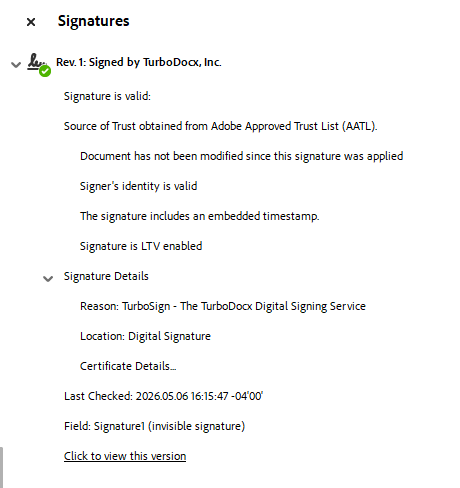
AATL Trusted
Certificate authority vetted and approved by Adobe's trust program
Green Checkmark
Recipients instantly see that the signature is valid and trusted
Tamper Detection
Adobe Acrobat verifies the document has not been modified since signing
E-Signature Acceptance by Country
While eIDAS provides the EU-wide framework, each country has its own supplementary legislation. Here's how key European markets recognize electronic signatures.
🇩🇪Germany
Vertrauensdienstegesetz (VDG), BGB
eIDAS directly applicable. AES is widely accepted for commercial contracts and standard employment agreements. Certain document types — such as fixed-term employment clauses, non-competes, and suretyships — have stricter form requirements that may need QES or wet ink. Always consult local counsel for regulated transactions.
Source: BGB (English) ↗🇫🇷France
Code Civil Art. 1366-1367
eIDAS directly applicable. French law recognizes electronic signatures for most commercial and consumer contracts. QES benefits from a legal presumption of reliability; other signature types may need to demonstrate reliability if challenged. Notarial acts and certain real estate transactions require QES or wet ink.
Source: Art. 1366-1367 (Légifrance) ↗🇳🇱Netherlands
Art. 3:15a Burgerlijk Wetboek
Dutch law follows freedom of form — contracts are generally valid regardless of how they are signed. Electronic signatures have the same legal effect as handwritten signatures when the method is sufficiently reliable. AES is accepted for commercial contracts. Notarial deeds (real estate, family law) still require a notary.
Source: Art. 3:15a BW (wetten.overheid.nl) ↗🇪🇸Spain
Ley 6/2020, eIDAS (EU) 910/2014
eIDAS directly applicable. Ley 6/2020 complements eIDAS with national supervision and sanctions. AES is accepted for most commercial, employment, and consumer contracts. Mortgage contracts, notarial acts, real estate transfers, and public administration dealings typically require QES or wet ink.
Source: Ley 6/2020 consolidated (BOE) ↗🇮🇹Italy
Codice dell'Amministrazione Digitale (CAD)
One of Europe's earliest digital signature frameworks. eIDAS directly applicable. AES (firma elettronica avanzata) is valid for most private contracts but has certain scope limitations under Italian law. Public administration filings and real estate transactions generally require QES or firma digitale (Italy's form of QES).
Source: CAD (Normattiva) ↗🇸🇪🇩🇰🇫🇮🇳🇴Nordics
National eIDAS implementations
All four countries follow freedom of form for most contracts. Each has its own national eID scheme — Swedish BankID, Norwegian BankID, Danish MitID, and Finnish strong authentication — providing identity verification. eIDAS applies to EU members (SE, DK, FI); Norway aligns through the EEA Agreement. Real estate transactions in all four countries have additional form requirements.
Source: Sweden Lag 2016:561 ↗🇬🇧United Kingdom
UK eIDAS (retained EU law), ECA 2000
Post-Brexit, the UK retained eIDAS trust services provisions. AES has the same domestic legal effect as under EU eIDAS. Cross-border mutual recognition between UK and EU no longer applies automatically. The Law Commission (2019) confirmed e-signatures can meet statutory signature requirements. Wills and certain deeds remain exceptions.
Source: SI 2016/696 (legislation.gov.uk) ↗🇮🇪Ireland
Electronic Commerce Act 2000
eIDAS directly applicable. The Electronic Commerce Act 2000 provides that electronic signatures cannot be denied legal effect solely because they are electronic. AES is sufficient for most commercial, employment, and insurance contracts. Wills, enduring powers of attorney, and affidavits still require wet ink.
Source: Electronic Commerce Act 2000 (Irish Statute Book) ↗🇵🇱Poland
Ustawa o usługach zaufania, Kodeks cywilny
eIDAS directly applicable. AES is valid for most commercial contracts. Polish law distinguishes between "documentary form" and "written form" — certain regulated transactions (employment, powers of attorney, consumer credit) have stricter form requirements that may require QES. Real estate and company formation typically require a notary.
Source: Act on Trust Services (ISAP) ↗🇨🇿Czech Republic
Act No. 297/2016, Civil Code
eIDAS directly applicable. Electronic signatures (including AES) are generally valid for most private contracts under the Civil Code. Public administration filings require at least an AES based on a qualified certificate. Real estate cadastre filings have additional certification requirements. Company formation requires a notary.
Source: Act 297/2016 (DIA, English translation) ↗When is QES Required?
A small number of transactions in certain EU jurisdictions require Qualified Electronic Signatures. These are the exception, not the rule.
Real estate transfers
In some jurisdictions (e.g., Germany, Austria), property transfers require notarization and QES or wet ink
Notarial acts
Documents requiring a notary public typically need QES or physical presence
Certain public sector filings
Government procurement portals and regulatory filings may specify QES in some member states
Certain employment documents (Germany)
Some employment-related documents — such as fixed-term clauses and non-competes — have stricter form requirements under German law that may require QES or wet ink. Consult local counsel for specifics.
For the majority of everyday business contracts — including sales agreements, NDAs, SOWs, and procurement documents — AES is widely accepted across the EU. Some jurisdictions have stricter requirements for specific document types (e.g., employment, real estate). Always consult local counsel for regulated transactions. TurboDocx's AES implementation covers the documents most businesses sign every day.
Frequently Asked Questions
Are e-signatures legally binding in the EU?
Yes. Under the eIDAS Regulation (EU 910/2014), electronic signatures cannot be denied legal effect solely because they are in electronic form. Advanced Electronic Signatures (AES) carry strong evidential weight and are widely accepted for business contracts across the EU. Specific requirements vary by country and document type.
What is the difference between AES and QES?
Advanced Electronic Signatures (AES) are uniquely linked to the signatory, capable of identifying them, and detect any subsequent changes to the signed data. Qualified Electronic Signatures (QES) meet all AES requirements plus use a qualified certificate issued by a government-accredited trust service provider and a secure signature creation device. QES is the only type that automatically equals a handwritten signature in all EU member states.
Do I need QES for employment contracts in Germany?
For standard indefinite employment contracts in Germany, AES is generally accepted. However, certain employment-related documents — such as fixed-term clauses, non-competes, and termination notices — have stricter form requirements under German law that may require QES or wet ink. We recommend consulting local counsel for specific document types.
Is TurboDocx eIDAS compliant?
Yes. TurboSign implements Advanced Electronic Signatures (AES) using ETSI CAdES standards, SHA-256 cryptographic hashing, and HSM-protected signing keys (FIPS 140-3). Every signature includes a tamper-evident audit trail with cryptographic hash chaining, signer identification, and optional RFC 3161 timestamps for long-term validation.
Can I use TurboDocx e-signatures for cross-border EU contracts?
Yes. One of the core principles of eIDAS is mutual recognition — an electronic signature that is legally valid in one EU member state must be accepted across all 27 member states. TurboDocx AES signatures are recognized throughout the EU, EEA, and in the UK under retained eIDAS provisions.
How does TurboDocx ensure signature integrity?
TurboDocx uses SHA-256 cryptographic hashing and ETSI CAdES detached signatures to ensure that any modification to a signed document is immediately detectable. Signing keys are protected in FIPS 140-3 certified hardware security modules and never leave the HSM. A tamper-evident audit trail records every action with cryptographic hash chaining, IP addresses, device fingerprints, and timestamps.
Sources & References
- eIDAS Regulation (EU 910/2014) — Consolidated text (EUR-Lex)
- eIDAS Article 25 — Legal effects of electronic signatures — EUR-Lex
- eIDAS Article 26 — Requirements for Advanced Electronic Signatures — EUR-Lex
- ETSI EN 319 122-1 — CMS Advanced Electronic Signatures (CAdES) — ETSI (PDF)
- FIPS 140-3 — Security Requirements for Cryptographic Modules — NIST CSRC
- Adobe Approved Trust List (AATL) — Adobe Help Center
- Germany: BGB §126a — Electronic Form — Official English Translation
- Germany: §14 TzBfG — Fixed-term employment written form — gesetze-im-internet.de
- France: Code Civil Art. 1366-1367 — Electronic signature definition & presumption — Légifrance
- Spain: Ley 6/2020 — Electronic trust services (consolidated) — Boletín Oficial del Estado
- Italy: CAD (D.Lgs. 82/2005) — Codice dell'Amministrazione Digitale — Normattiva
- Netherlands: Art. 3:15a BW — Electronic signature validity — wetten.overheid.nl
- Ireland: Electronic Commerce Act 2000 — Irish Statute Book
- Poland: Ustawa o usługach zaufania — Act on Trust Services (Dz.U. 2024 poz. 1725) — ISAP (Sejm)
- Czech Republic: Act 297/2016 Coll. — Trust Services for Electronic Transactions — DIA (English translation)
- UK: SI 2016/696 — Electronic Identification and Trust Services Regulations — legislation.gov.uk
Related Resources
US Compliance Guide
E-Signature Compliance in the US
ESIGN Act and UETA make e-signatures binding in all 50 states. See how TurboDocx meets federal requirements.
Read guideTechnical Guide
Electronic vs. Digital Signatures
Understand the technical differences between electronic signatures and cryptographic digital signatures.
Read guideProduct
TurboSign E-Signatures
Sign documents online with 5 free signatures per month. No subscription required to start.
Learn moreStart Signing in Europe Today
TurboDocx delivers eIDAS-compliant Advanced Electronic Signatures with HSM-backed cryptography, tamper-proof audit trails, and cross-border recognition across all 27 EU member states. Your first 5 signatures each month are free.