E-Signatures in the US: Legal, Compliant, and Binding
Electronic signatures are legally binding in all 50 US states under the ESIGN Act and UETA. Learn how TurboDocx meets federal e-signature requirements.
Quick Answer
Yes — electronic signatures are legally binding in all 50 US states. The federal ESIGN Act (2000) and the Uniform Electronic Transactions Act (UETA) together ensure that e-signatures carry the same legal weight as handwritten signatures for most commercial transactions.
ESIGN Act — All 50 States
UETA — 49 States + DC
ESIGN Compliant
What are the ESIGN Act and UETA?
The ESIGN Act (Electronic Signatures in Global and National Commerce Act — 15 U.S.C. §7001 et seq.) is a federal law signed on June 30, 2000. It establishes that electronic signatures and electronic records cannot be denied legal effect solely because they are in electronic form. ESIGN applies to all interstate and international commerce and serves as the federal baseline across all 50 states.
The Uniform Electronic Transactions Act (UETA) is a model state law proposed in 1999 by the Uniform Law Commission. It has been adopted by 49 states, the District of Columbia, Puerto Rico, and the US Virgin Islands. UETA provides a complementary state-level framework that governs electronic transactions within individual states.
Together, ESIGN and UETA create a comprehensive legal framework: ESIGN covers federal and interstate transactions, while UETA handles intrastate transactions at the state level. The key principle shared by both laws is simple — a signature or record cannot be denied legal effect solely because it is in electronic form. For a deeper look at the technical mechanisms that make this possible, see our guide on how electronic signatures work.
What Makes an E-Signature Valid Under ESIGN?
The ESIGN Act establishes four core requirements for a valid electronic signature. Any e-signature platform must satisfy all four to produce legally enforceable signatures. For a practical walkthrough of the signing process, see how to sign a PDF.
Intent to Sign
15 U.S.C. §7001(a)TurboSign requires an affirmative action to sign — the signer must actively click to apply their signature. Accidental or passive signatures are not possible. The audit trail records the signer's deliberate intent.
Consent to Electronic Transactions
15 U.S.C. §7001(c)Before signing, each party consents to conduct the transaction electronically. TurboSign presents and records this consent as part of the signing workflow.
Association of Signature with Record
15 U.S.C. §7001(a)Each signature is cryptographically bound to the signed document using SHA-256 hashing and ETSI CAdES detached signatures. Any modification to the document after signing is immediately detectable.
Record Retention
15 U.S.C. §7001(d)TurboSign retains the signed document, all signature data, and the complete audit trail in a tamper-evident format. Records remain accessible and reproducible for the legally required retention period.
ESIGN defines an electronic signature broadly: “an electronic sound, symbol, or process, attached to or logically associated with a contract or other record and executed or adopted by a person with the intent to sign the record.” This intentionally broad definition covers a wide range of signing methods — from typed names to cryptographic digital signatures.
How TurboDocx Meets ESIGN Requirements
TurboSign, the e-signature engine within TurboDocx, satisfies every ESIGN requirement and goes beyond the minimum with cryptographic security and tamper-evident audit trails. Developers can also integrate these capabilities programmatically via the TurboDocx API & SDK.
Intent to Sign
15 U.S.C. §7001(a)TurboSign requires an affirmative action to sign — the signer must actively click to apply their signature. Accidental or passive signatures are not possible. The audit trail records the signer's deliberate intent.
Consent to Electronic Transactions
15 U.S.C. §7001(c)Before signing, each party consents to conduct the transaction electronically. TurboSign presents and records this consent as part of the signing workflow.
Association of Signature with Record
15 U.S.C. §7001(a)Each signature is cryptographically bound to the signed document using SHA-256 hashing and ETSI CAdES detached signatures. Any modification to the document after signing is immediately detectable.
Record Retention
15 U.S.C. §7001(d)TurboSign retains the signed document, all signature data, and the complete audit trail in a tamper-evident format. Records remain accessible and reproducible for the legally required retention period.
HSM-Protected Signing Keys
InfrastructureAll signing operations execute within FIPS 140-3 certified hardware security modules (HSMs). Private keys never leave the HSM boundary, ensuring the highest level of cryptographic security.
Comprehensive Audit Trail
EvidentiaryEvery action — sending, viewing, signing — is timestamped and chained using SHA-256 hashes. The audit trail records IP addresses, device fingerprints, geolocation, and user agent for each event.
Long-Term Validation
ArchivalOptional RFC 3161 timestamps and embedded certificate chains enable signature verification years after signing — critical for contracts with long retention periods.
Verified in Adobe Acrobat
TurboSign signatures use certificates from the Adobe Approved Trust List (AATL) — Adobe's program of vetted certificate authorities whose digital signatures are automatically trusted by Adobe Acrobat and Adobe Reader worldwide. When a recipient opens a TurboSign-signed PDF, they see a green checkmark confirming the signature is valid and the document has not been tampered with.
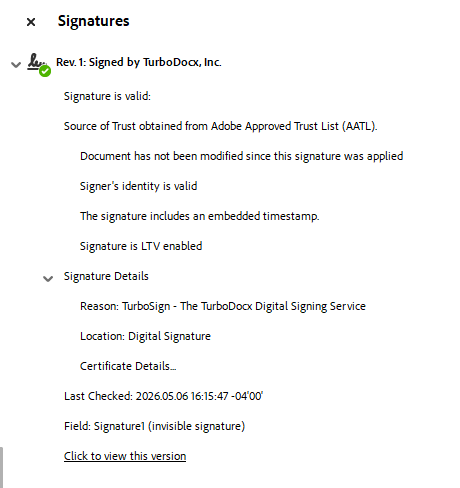
AATL Trusted
Certificate authority vetted and approved by Adobe's trust program
Green Checkmark
Recipients instantly see that the signature is valid and trusted
Tamper Detection
Adobe Acrobat verifies the document has not been modified since signing
State-Level E-Signature Laws
While the federal ESIGN Act provides a nationwide baseline, most states have also adopted UETA to govern electronic transactions at the state level. Here's how the state landscape breaks down.
49 States + DC Have Adopted UETA
The vast majority of US jurisdictions — 49 states, the District of Columbia, Puerto Rico, and the US Virgin Islands — have adopted UETA. In these states, electronic signatures and electronic records are treated the same as their paper equivalents for transactions where all parties agree to conduct business electronically.
UETA states follow a consistent framework: both parties must agree to transact electronically, the electronic signature must be attributable to the signer, and electronic records must be retained in a form that can be accurately reproduced. Individual states may have additional requirements for specific transaction types — always check your state's specific provisions.
🗽New York — Electronic Signatures and Records Act (ESRA)
State Technology Law, Article 3
New York is the only state that has not adopted UETA. Instead, it enacted its own Electronic Signatures and Records Act (ESRA), which takes a technology-neutral approach — it does not mandate any specific technology or standard for electronic signatures. E-signatures are valid in New York for most commercial transactions under both ESRA and the federal ESIGN Act.
Source: NY ITS — ESRA Overview ↗Bottom line:Regardless of which state you're in, electronic signatures are legally valid for most commercial transactions. The federal ESIGN Act applies everywhere, and 49 states plus DC have also adopted UETA at the state level. New York has its own equivalent framework (ESRA). State-specific exceptions may apply to certain document types — consult local counsel for regulated transactions.
Industry Considerations
While the ESIGN Act applies broadly, certain industries have additional regulations that affect how e-signatures can be used. For high-volume workflows, TurboSign supports bulk signature sendingto handle onboarding packets, policy acknowledgments, and compliance documents at scale. Here's a high-level overview — always consult industry-specific counsel for regulated transactions.
Real Estate
E-signatures are accepted for most real estate documents — including purchase agreements, leases, and disclosures — in the majority of states. However, deeds, mortgages, and title transfers may have additional state-specific requirements. Some states require notarization for certain documents, though Remote Online Notarization (RON) is now available in most states.
Healthcare
HIPAA does not prohibit electronic signatures for healthcare documents. E-signatures are widely used for patient consent forms, HIPAA authorization, and provider agreements. The key requirement is maintaining the security and integrity of protected health information (PHI). Some states have additional requirements for certain healthcare documents.
Financial Services
Banks, lenders, and financial institutions widely use e-signatures for loan applications, account openings, and investment agreements. The ESIGN Act specifically covers financial services transactions. SEC and FINRA have issued guidance accepting electronic signatures for many regulated documents, though certain disclosures may have specific delivery requirements.
Government Contracts
The federal Government Paperwork Elimination Act (GPEA) allows federal agencies to accept electronic signatures. Many state and local governments also accept e-signatures for procurement and contracting. Requirements vary by agency — check the specific agency's electronic signature policy before relying on e-signatures for government filings.
Frequently Asked Questions
Are e-signatures legally binding in the United States?
Yes. The federal ESIGN Act (2000) gives electronic signatures the same legal status as handwritten signatures for most commercial transactions. The UETA, adopted by 49 states plus DC, provides a complementary state-level framework. Together, they ensure e-signatures are valid across the country.
What is the difference between the ESIGN Act and UETA?
The ESIGN Act is a federal law that applies nationwide to interstate and international commerce. UETA is a model state law adopted individually by 49 states and DC. Both establish that e-signatures cannot be denied legal effect solely because they are electronic. ESIGN serves as a federal backstop in states that haven't adopted UETA or have conflicting provisions.
Is TurboDocx ESIGN Act compliant?
Yes. TurboSign captures signer intent through affirmative action, records consent to electronic transactions, cryptographically links each signature to the signed document using SHA-256 hashing, and retains complete audit trails for record retention. All signing keys are protected in FIPS 140-3 certified hardware security modules.
Can I use e-signatures for real estate transactions?
For most real estate documents — including purchase agreements, leases, and disclosures — e-signatures are accepted in the majority of US states. However, requirements vary by state, and some transactions (such as deeds, mortgages, and title transfers) may have additional requirements. Always check your state's specific real estate laws.
Sources & References
- ESIGN Act (15 U.S.C. §7001 et seq.) — Public Law 106-229 (GovInfo)
- ESIGN Act — U.S. Code — 15 U.S.C. Chapter 96 (Cornell Law)
- Uniform Electronic Transactions Act (UETA) — Uniform Law Commission
- UETA Enactment Map — ULC Legislative Tracking
- New York ESRA — NY ITS — ESRA Overview
- Government Paperwork Elimination Act (GPEA) — S.2107 (Congress.gov)
- FIPS 140-3 — Security Requirements for Cryptographic Modules — NIST CSRC
- Adobe Approved Trust List (AATL) — Adobe Help Center
Related Resources
EU Compliance Guide
E-Signature Compliance in Europe
Learn how eIDAS makes electronic signatures binding across all 27 EU member states and how TurboDocx meets AES requirements.
Read guideGlobal Guide
Are Electronic Signatures Legal?
Global overview of e-signature legality across 180+ countries, including ESIGN Act, UETA, and eIDAS.
Read guideProduct
TurboSign E-Signatures
Sign documents online with 5 free signatures per month. No subscription required to start.
Learn moreStart Signing with Confidence
TurboDocx delivers ESIGN-compliant electronic signatures with HSM-backed cryptography, tamper-proof audit trails, and Adobe AATL trust validation. Your first 5 signatures each month are free.